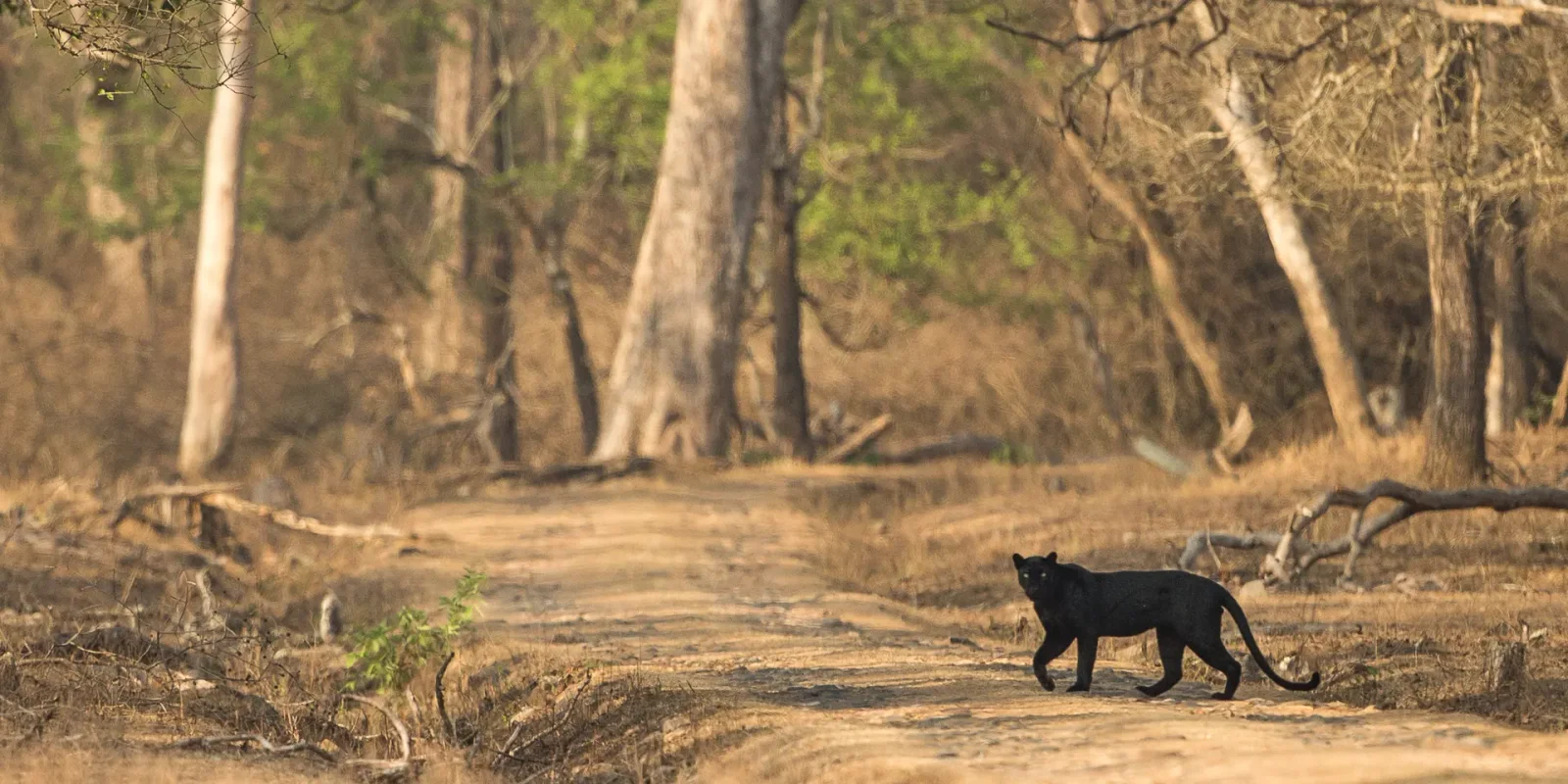
Few animals carry as much myth as the black panther. In India it is the leopard you were told about as a child, Bagheera of The Jungle Book, and the cat photographers chase for years. The reality is both simpler and more interesting: a black panther is an ordinary leopard whose coat has turned dark because of a single gene.
This guide explains what a black panther is, where black leopards have been recorded in India, what happened in Pench in 2024, and how to plan a trip that gives you a fair chance without pretending a sighting can be booked.
What Is a Black Panther?
“Panther” is an old name for any big cat of the genus Panthera. In India, a black panther is a melanistic leopard, Panthera pardus, the same species as the spotted leopards you see in Tadoba or Jhalana. In the Americas the same name is used for black jaguars.
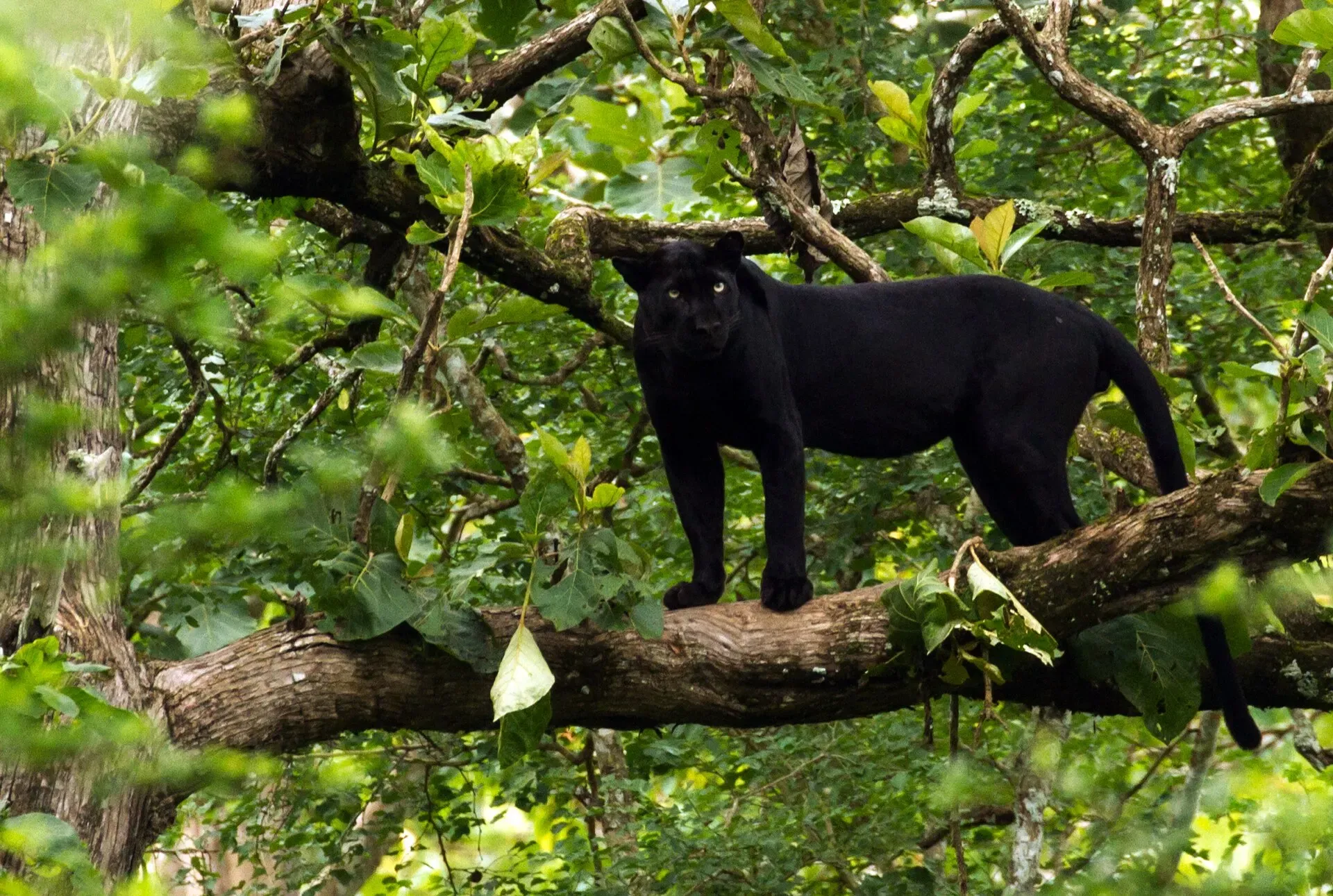
A black leopard is not a separate species or subspecies. It mates with normally coloured leopards, and a single litter can include both spotted and black cubs. In good, low-angled light you can still see the rosettes under the dark coat, like a pattern printed in black on black.
Why Some Leopards Are Black: Melanism Explained
The dark coat is caused by melanism, an excess of dark pigment. In leopards, a 2012 study in PLoS ONE by Schneider and colleagues traced it to a mutation in the ASIP (agouti signalling protein) gene. The mutation switches the gene off, so the pigment cells keep producing dark pigment instead of alternating with yellow.
The trait is recessive: a cub is black only if it inherits the variant from both parents. That is why black leopards appear in clusters where the gene is common in the local population, and why two spotted parents can produce a black cub. The study noted that melanism reaches very high frequencies in some Asian leopard populations, especially in dense, humid forest.
Why Black Leopards Live in Dense Forest
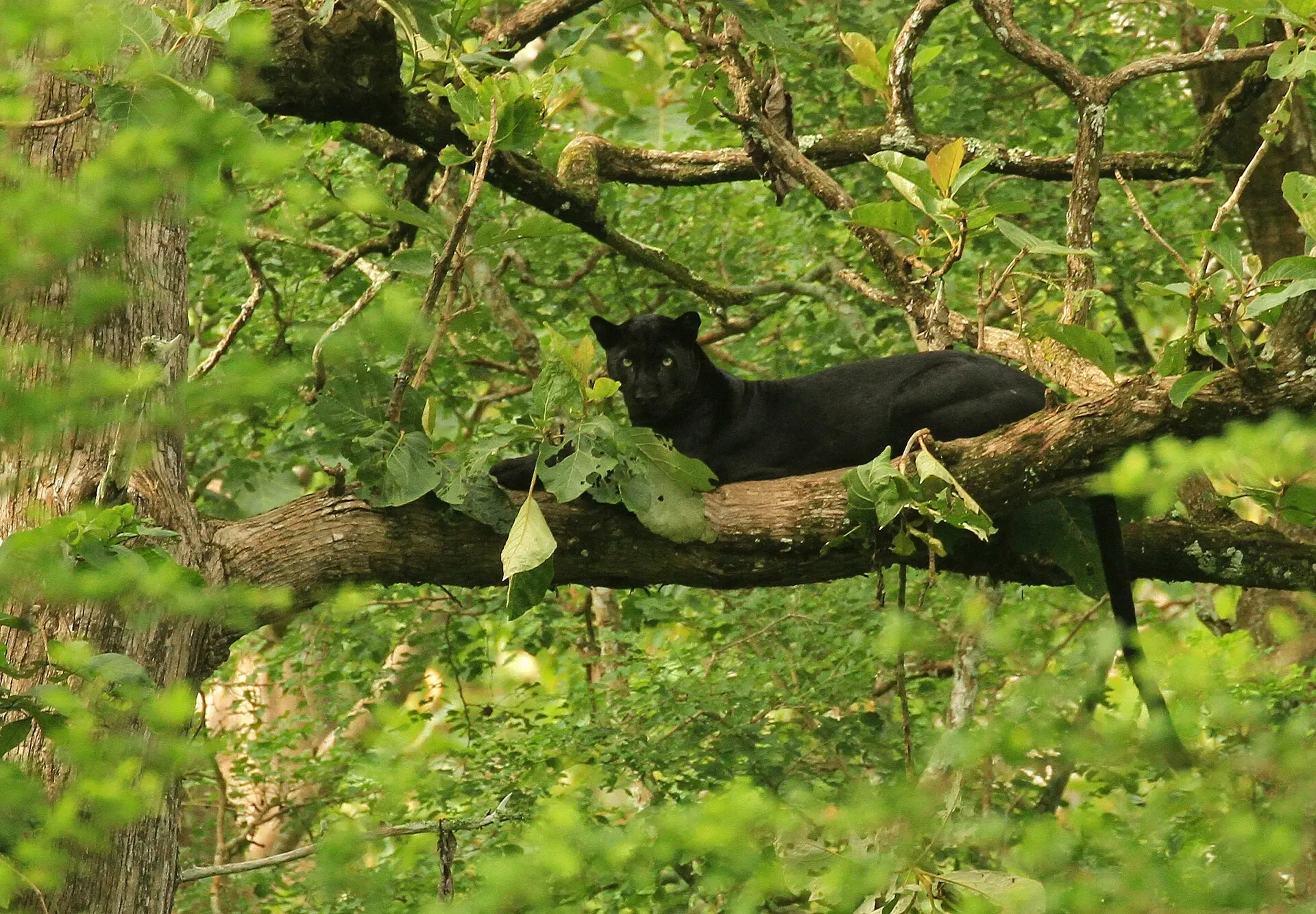
Most black leopards in India are recorded in wet, dense forest: the Western Ghats of Karnataka and Kerala, and the moister parts of Central India. A dark coat is hard to see in deep shade, which may help an ambush hunter. In open, dry country a black coat stands out, and black leopards are rarely reported there.
This is a pattern, not a rule. Pench and Tadoba are dry deciduous forests, yet both have recorded black leopards, usually in shadier, well-wooded patches.
Where to See a Black Panther in India
Kabini, Nagarhole National Park (Karnataka). India’s most famous black leopard, a male known as Saya (“shadow”), became widely known through the photographer and filmmaker Shaaz Jung. Kabini’s mix of jeep and boat safaris and its tree-rich forest make it the most likely place to see one, though even here sightings are a matter of luck and many drives.
Kali (Dandeli-Anshi) Tiger Reserve (Karnataka). The wet forests of the Kali reserve have regular reports of black leopards. Tourism here is smaller in scale, which suits patient travellers.
Pench (Madhya Pradesh). Pench Tiger Reserve photographed a black leopard cub with its mother near the Turia gate in 2024 (details below). Earlier sightings were reported in November 2020.
Tadoba-Andhari (Maharashtra). Melanistic leopards have been photographed on Tadoba’s Pangdi–Kolsa side. Tadoba is a tiger-first reserve, so a black leopard is a rare bonus.
Other forests. Black leopards have also been reported from other Western Ghats and northeast forests. Reports come and go as individuals live, die and disperse, so recent field information matters more than any list.
Pench’s Black Panther: Bagheera
In May 2024 Pench Tiger Reserve shared photographs of a black leopard cub walking with its normally coloured mother near the Turia gate, and named it Bagheera, after the black panther who guards Mowgli in The Jungle Book. The pairing was fitting: Kipling set the Mowgli stories in the Seoni hills around Pench.
A spotted mother with a black cub is a textbook example of recessive inheritance. Like any leopard, the cub would later disperse and establish its own range, so a 2024 sighting is not a promise of a sighting today. Read about Pench’s other famous cats in the famous tigers of Pench.
Black Panther vs Leopard vs Jaguar
Black leopard (India, Africa, Asia): Panthera pardus with melanism. Slender, long-tailed, rosettes faintly visible.
Spotted leopard: the same species with a golden coat and rosettes. Far more common.
Black jaguar (Americas only): Panthera onca with melanism. Stockier, with a broader head; not found in India.
Bagheera: Kipling’s character is a black panther, so the name is used for black leopards in India, including the Pench cub.
Black Panther Myths and Facts
Myth: black panthers are more aggressive than spotted leopards. There is no evidence for this. Behaviour depends on the individual and the situation, not the coat colour.
Myth: a black panther is a hybrid. It is not. Both parents are leopards; the dark coat comes from a single recessive gene variant.
Myth: black panthers have no spots. They do. The rosettes are still there, hidden in the dark coat and visible in angled light.
Fact: black cubs can be born to spotted parents. If both parents carry the variant, each cub has a one-in-four chance of being black, which is how Pench’s spotted leopard mother came to raise a black cub.
Fact: there is no separate count. India’s leopard estimates do not split black and spotted leopards, so any number of black panthers you read online is an informal estimate.
Photographing a Black Leopard
A black coat swallows light, so exposure is the hardest part. Expose for the leopard rather than the bright sky or leaves around it, and accept that the background may burn out. Underexposed black fur loses all detail and cannot be recovered later.
Look for side light that shows the rosettes, and catch the eyes, which are often the only bright point in the frame. A long lens of 400–600 mm, a bean bag on the vehicle rail and patience matter more than a high frame rate. Never use flash on wildlife; it is banned and it ruins the frame.
Best Time to Look for a Black Leopard
In Central India, March to June is best: cover thins and animals come to water, so any leopard is easier to see. In Kabini, the dry season from February to May, when the Kabini reservoir draws animals to its banks, is the popular window. Monsoon closures apply to core zones in most reserves.
Leopards are most active at first and last light, so keep the early morning and late afternoon drives. Night tourism in tiger reserves is banned, so there is no legal after-dark option.
How We Would Plan a Black Panther Trip
Be honest about the odds. No operator can guarantee a black leopard. The best plan gives you many drives in a place with recent sightings and a good chance at other wildlife.
Western Ghats focus, 5–6 nights: Kabini for four to six drives, with boat safaris on the reservoir. Add Bandipur for tigers and elephants.
Central India, 6 nights: Pench and Tadoba, mixing core and buffer drives. You get strong tiger odds, regular spotted leopards, and a small chance of a black one. See our Pench packages and tigers and leopards tour.
Watching Black Leopards Responsibly
Rare animals attract crowds. Keep the required distance, never ask a driver to block or chase a leopard, never use playback or bait, and do not share precise locations of cubs or resting sites on social media. Follow the guide and the reserve’s rules. Read more on the Indian leopard.
Sources
Schneider A. et al. (2012), How the Leopard Hides Its Spots: ASIP Mutations and Melanism in Wild Cats, PLoS ONE 7(12): e50386; Pench Tiger Reserve, black panther cub with leopard mother (May 2024); The Hitavada, rare black leopard spotted at Pench (Nov 2020); NTCA and WII, Status of Leopards in India 2022. Checked 20 October 2026. Hero photo: Dheerajmnanda, CC BY-SA 4.0.
Frequently Asked Questions
Is a black panther a different species?
No. In India a black panther is a leopard (Panthera pardus) with melanism, a gene variant that darkens its coat. It breeds with spotted leopards.
Where can I see a black panther in India?
Kabini in Nagarhole National Park is the best-known place. Black leopards are also reported from the Kali Tiger Reserve, Pench and Tadoba. Sightings are rare.
Is there a black panther in Pench?
Yes. In 2024 Pench Tiger Reserve photographed a black leopard cub, named Bagheera, with its spotted mother near the Turia gate.
Why is a black panther black?
A recessive mutation in the ASIP gene switches off the signal for yellow pigment, so the coat stays dark. Both parents must carry the variant.
Can you still see spots on a black panther?
Yes. In low, angled light the rosettes show faintly under the black coat.
How many black panthers are there in India?
There is no official count of black leopards. They are counted as leopards; India had an estimated 13,874 leopards in 2022.
Ready to see it for yourself?
Browse Safari Tours