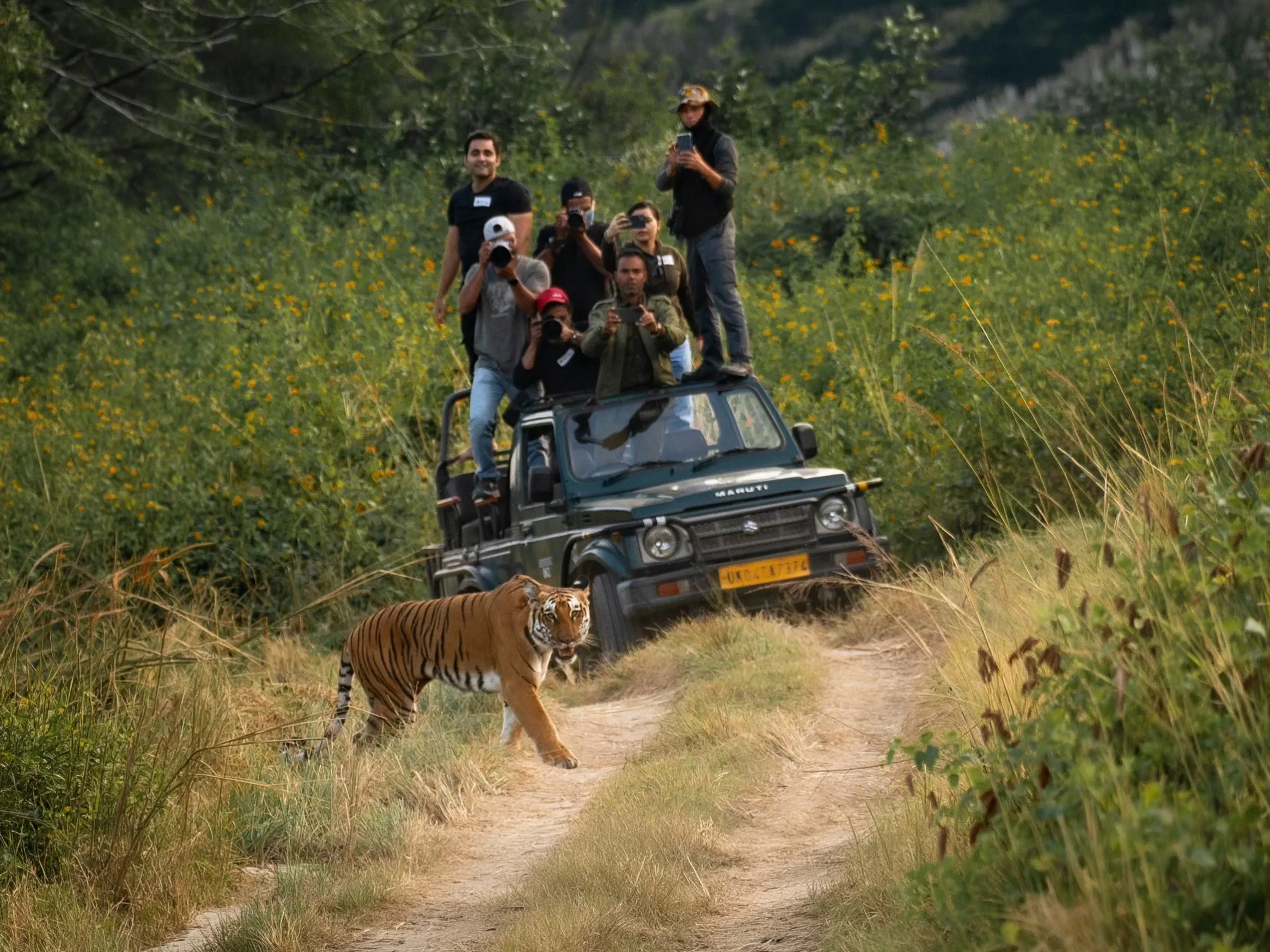
For a first India tiger safari from Canada, plan 10–14 days across two or three central-India reserves — most often Tadoba, Pench and Kanha or Bandhavgarh. Budget roughly CAD 2,600–3,800 per person, land-only and twin-share, before international flights. Travel November–February for comfortable weather or March–June for peak tiger activity. Wild Excursions books the permits, matches lodges to your gate, and runs every transfer and drive — you deal with one team, not a portal.
Canadian travellers researching an India tiger safari usually hit the same wall: plenty of inspiration, very little on how the trip is actually assembled. Permits are government-issued and zone-specific. Lodges are only useful if they sit near the right gate. Inter-park transfers cross state lines. This page is written from the operator’s side of that problem — what to book, when to travel, what it costs in Canadian dollars, and how the moving parts fit together.
Why book through a local Indian operator
The hard part of an India safari is not choosing a park — it is execution. Wild Excursions is based in Nagpur, at the centre of the tiger circuit, and handles the ground operation directly rather than passing it to a third party.
- Permits, booked at source. Zone permits are released on a government portal months ahead and sell out in minutes for peak dates. We book them directly, in your names, as part of the package.
- Lodges matched to your gate. A lodge an hour from the wrong gate costs you a safari. We pair accommodation to the zone and gate on your confirmed permit.
- Every transfer in a private vehicle. Airport, railway station and inter-park road legs are all arranged and driver-briefed — no local haggling on arrival.
- Licensed naturalists. Guides who read animal behaviour and work the forest ethically — permitted zones only, no off-track driving, no baiting.
- One point of contact. The same team plans the trip, runs it on the ground, and stays reachable throughout — across the time-zone gap.
Sample itineraries: 10, 12 and 14 days
These are the three structures we build most often for Canadian guests. Each is private by default and fully customisable — arrival city, park order, lodge tier and number of drives all move to fit you.
| Trip | Route | Parks & drives | Indicative from (land-only, pp) | Best months |
|---|---|---|---|---|
| 10 days | Nagpur → Tadoba → Pench → NagpurA focused first trip built around central India’s two most reliable tiger forests. | Two reserves · 5–6 safari drives | from approx. CAD 2,600 pp | Nov–Mar for comfort, Apr–Jun for sightings |
| 12 days | Nagpur → Tadoba → Pench → Kanha → JabalpurThe middle path — more forests, more drives, without a punishing pace. | Three reserves · 7–8 safari drives | from approx. CAD 3,200 pp | Nov–Mar, with Feb–Apr strong for Kanha |
| 14 days | Delhi or Mumbai → Tadoba → Pench → Kanha or Bandhavgarh → returnThe flagship: Tigers of Central India, with time to slow down and photograph. | Three reserves + arrival city · 8–10 safari drives | from approx. CAD 3,800 pp | Nov–Mar; Apr–Jun for the highest tiger-activity window |
The 14-day trip is our flagship — Tigers of Central India: Delhi or Mumbai arrival, then Tadoba, Pench and Kanha or Bandhavgarh, with private transfers, selected lodges, multiple safari drives, naturalists and complete permit coordination. See the full day-by-day itinerary.
What is included — and what is not
Included
- All forest entry permits, gate fees, gypsy (jeep) charges, driver and guide fees
- Naturalist-led safari drives in the zones on your permit
- Accommodation on twin-share, all meals, applicable GST
- All ground transfers — airport, station and inter-park — in a private vehicle
- On-ground coordination and a single point of contact for the whole trip
Not included
- International and domestic flights
- India e-Visa fee and travel insurance
- Camera / lens fees where a park levies them, tips, and personal expenses
- Anything not listed as included in your written itinerary
Safari permits, gates and zones — explained simply
Every Indian tiger reserve works on the same basic system. Understanding it makes the rest of the trip make sense.
Zones
Each park is split into numbered zones. Some are tiger-dense and heavily booked; others are quieter with better birding and landscape. A permit is for one specific zone per drive.
Gates
Each zone is entered through a particular gate, sometimes an hour or more apart by road. Which gate you use decides which lodges are practical — this is the pairing we handle for you.
Drive slots
Two drives a day: a pre-dawn morning drive and an afternoon drive, each roughly three to four hours. Timings shift by season. Vehicles are open 4x4 gypsies with a driver and a park-assigned guide.
Booking window
Permits open on a government portal 90–120 days ahead and can sell out within minutes for weekends and holidays. We book the moment the window opens; this is the single biggest reason to commit dates early.
Best months to visit each reserve
Central-India parks are closed through the monsoon (broadly July to mid-October) and open again for the dry season. Use this as orientation and confirm current-year dates when you book.
| Reserve | Season & best window | What defines it |
|---|---|---|
| Tadoba (Maharashtra) | Open mid-Oct to Jun; best Mar–Jun | Highest tiger density in central India; hot but very rewarding in the dry months. |
| Pench (MP / Maharashtra) | Open Oct to Jun; best Feb–May | Open teak forest, excellent for photography and birdlife; pairs naturally with Tadoba. |
| Kanha (Madhya Pradesh) | Open Oct to Jun; best Feb–Apr | Large sal-forest landscape, barasingha (swamp deer) and strong tiger numbers. |
| Bandhavgarh (Madhya Pradesh) | Open Oct to Jun; best Feb–Jun | Small park, high density, arguably India’s best odds of a sighting per drive. |
| Ranthambore (Rajasthan) | Open Oct to Jun; best Apr–Jun | Dramatic fort-and-lake backdrop, easy to add from Delhi or Jaipur. |
More detail in our best time to visit India’s jungles guide, and by reserve on the Tadoba, Pench, Kanha and Bandhavgarh pages.
Flight-arrival guidance from Toronto, Vancouver and Montreal
| Departure | Getting to Delhi / Mumbai | Onward to the parks |
|---|---|---|
| Toronto (YYZ) | One stop via Europe (Frankfurt, Zurich, London, Paris) or the Gulf (Doha, Abu Dhabi, Dubai); ~15–18 h total | Domestic flight to Nagpur (for Tadoba / Pench) or Jabalpur (for Kanha / Bandhavgarh), then a road transfer |
| Montreal (YUL) | One stop via Europe or the Gulf; similar total time to Toronto | Same — Nagpur or Jabalpur, then road |
| Vancouver (YVR) | One or two stops via the Gulf, Hong Kong or Europe; ~18–22 h total | Same — Nagpur or Jabalpur, then road |
We recommend arriving a day before the first safari to absorb the time change (India is UTC+5:30 — 9.5 to 12.5 hours ahead of Canadian time zones). We plan the internal legs around your confirmed international flights, not the other way round.
How the cost works in Canadian dollars
Our packages are priced in Indian rupees and settled by international bank transfer; the CAD figures on this page are indicative conversions. What moves the number most:
- Lodge tier. Mid-range forest lodges versus premium and luxury properties can double the land cost. We quote both.
- Private vs small-group. A private vehicle and guide for your party costs more per person than sharing; most Canadian guests choose private.
- Season. Peak months (March–June, and holiday weeks) carry higher permit demand and lodge rates.
- Number of drives. More zones and more drives add permit and jeep cost.
Payment and deposits: booking is confirmed with a 50% advance, with the balance due 30 or more days before departure.
For a full line-by-line breakdown — permit, jeep, guide, lodge, transfers and tax — and pricing by trip length, see our India tiger safari cost guide.
Cancellation and payment policy
| Cancelled | Refund |
|---|---|
| 120+ days before departure | 100% |
| 60–120 days before | 75% |
| 45–60 days before | 50% |
| 30–45 days before | 25% |
| Within 30 days / no-show | 0% |
Refunds are processed within 7–8 working days, less any bank or transaction fees. Free rebooking to new dates is offered as an alternative to a refund. Full terms are on our terms page. We strongly recommend comprehensive travel insurance for every traveller.
Safety and official Canadian guidance
Before you book, and again before you fly, check the current Government of Canada travel advice for India. Canada specifically advises travellers to use reputable professional guides and follow park regulations.
On safari, that is how Wild Excursions works by default: licensed naturalists on every drive, permitted zones only, defined forest tracks, no off-road driving and no baiting. Vehicles carry first aid; lodges are vetted; and our team is a phone call away throughout your trip, wherever you are.
Reviews and track record
Wild Excursions holds a 4.9-star guest rating across 1,000+ verified reviews, and is listed on Tripadvisor. You can read guest experiences on our about page and on individual tour pages.
India tiger safari from Canada — FAQs
How much does an India tiger safari cost from Canada in CAD?
As a planning anchor, a multi-park private trip with mid-range lodges runs roughly CAD 2,600–3,800 per person for 10–14 days, land-only and twin-share, before international flights. Premium lodges add materially to that. These are indicative bands converted from our rupee pricing — every trip is quoted in writing after we confirm your dates, parks and lodge tier.
What is the best India tiger safari itinerary for a first trip?
For most first-time Canadian travellers, 12–14 days across Tadoba, Pench and Kanha (or Bandhavgarh) is the strongest structure: three genuinely different forests, 7–10 safari drives, and enough margin that one quiet park does not define the trip. Ten days works if you keep it to two reserves.
When is the best time to see tigers in India?
March to June gives the highest tiger activity — water is scarce, so animals move to predictable points — but it is hot. November to February is far more comfortable and still very good, with cold early mornings. Canadians travelling in their winter get the pleasant end of the range; those chasing peak sightings come in spring.
Do Canadians need a visa for India?
Yes. Canadian passport holders apply online for an India e-Visa (tourist) before travelling. We send a checklist with timelines when you book, but the visa itself is applied for by the traveller directly through the official Government of India portal.
How do I get from Toronto, Vancouver or Montreal to the tiger reserves?
Fly into Delhi or Mumbai (one-stop from Toronto and Montreal via Europe or the Gulf; usually one or two stops from Vancouver). From there it is a short domestic flight to Nagpur or Jabalpur, then a road transfer we arrange. Total door-to-gate is typically a travel day plus a domestic leg — we build the itinerary around your confirmed flights.
Is an India tiger safari suitable for seniors?
Yes, and many of our guests are retired travellers. Safari drives are on defined forest tracks in an open 4x4, not walking safaris. We can pair you with lodges close to the gate to shorten pre-dawn drives, keep the daily pace gentle, and brief drivers on mobility needs. Share any health considerations at planning stage.
What are safari permits and zones, and does Wild Excursions handle them?
Each reserve is divided into zones, and entry is by a dated permit tied to a specific zone, gate and drive slot — released on a government portal months ahead and often sold out within minutes for peak dates. We book permits directly as part of your package, match lodges to the gate on your permit, and handle the guide and jeep allocation at the gate. You do not deal with the portal.
How does an India tiger safari compare to an African safari for Canadians?
Land costs are typically a fraction of an equivalent East or Southern African safari, and the flight time from Canada is broadly similar. The experience is different: India is forest rather than open savannah, drives are on fixed routes, and the headline animal is the tiger rather than the big cats and plains game of Africa. Many of our guests have done both.
Is it safe, and what does the Government of Canada advise?
Check travel.gc.ca/destinations/india for current official guidance before you book and again before you fly. Canada advises travellers to use reputable professional guides and follow park regulations — which is exactly how we operate: licensed naturalists, permitted zones only, and no off-track driving or baiting.
About the author

Hardik founded Wild Excursions in 2022 and coordinates permits, gates, stays, safari vehicles and road transfers for Indian wildlife journeys, including private trips for international travellers across central India. This guide was written for Canadian travellers and last updated on 8 September 2026.
Book a 20-minute planning call
Tell us your travel month, group size and what you want from the trip. We’ll come back with a route, a lodge-tier comparison and a written price in CAD terms — no obligation.
Open the safari enquiry form